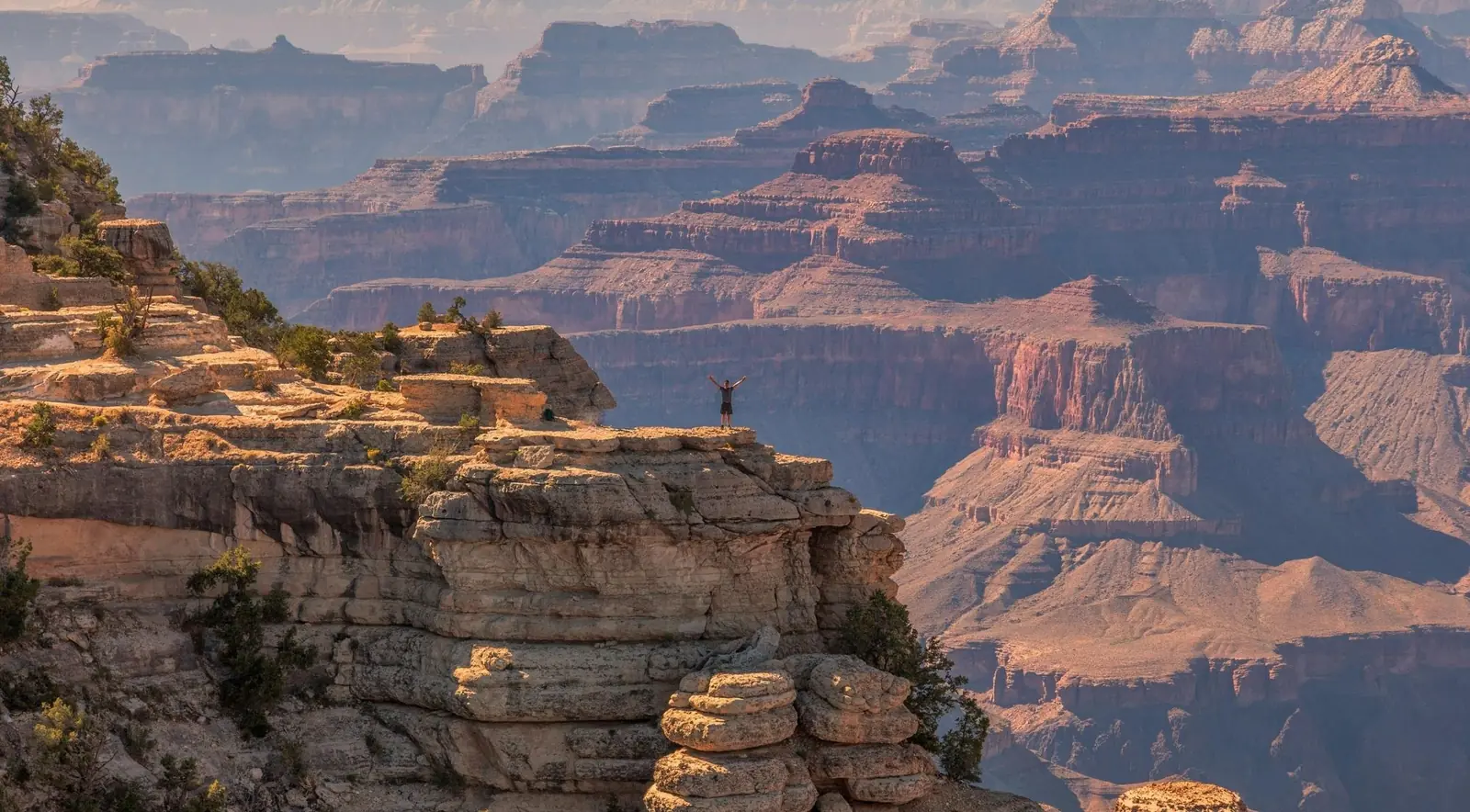
Spring and Fall Are the Easiest Months to Fly
April, May and October are the best months for a Grand Canyon helicopter tour from Las Vegas. Grand Canyon West, where these flights land, is open every day of the year, so the month matters for weather, not for access. All three sit outside the thunderstorm season, which the National Park Service puts in July, August and early September, with storms mostly between 11 a.m. and 6 p.m. In April and May the park also warns of wind, calling spring breezy to windy with gusts occasionally over 40 mph. Then there is the heat. Grand Canyon West has no long-term weather station. The nearest, at Meadview, averages daily highs of 76 in April, 86 in May and 79 in October, against 102 in July. Meadview also sits higher than your landing spot, which is about 3,500 feet below the rim near the Colorado River, so read those figures as the mild end of what you will be standing in. In July and August your departure time matters more than your date: Maverick says the West Rim can pass 100 degrees, and that morning flights are often cooler. We would book the flight early in your Las Vegas stay rather than on your last morning, because a thunderstorm can get your slot moved and you need a spare day to take the new one.
| What it turns on | April | October |
|---|---|---|
| Thunderstorm risk | Low | Low |
| Canyon-floor heat | Comfortable | Comfortable |
| Wind | Breezy to windy season | Outside that season |
| Daylight, mid-month | 13h 05m | 11h 19m |
| Rain on the South Rim, whole month | 0.64 in | 1.23 in |
Neither month wins outright. April gives you the longer day, October keeps you out of the spring wind season. Pick on whichever of those two you care about, and book the flight early in your stay either way.
Grand Canyon West is open every day of the year, and Maverick’s own seasonal advice covers winter bookings as well as summer ones, so these flights run in every season. An individual flight can still be moved by weather. Month to month, four things change: how hot the ground is when you land, how likely an afternoon storm is, how settled the air is, and how long the day lasts. Those things do not peak together, which is why there are two good windows rather than one.
If your dates are already fixed, you have not picked badly. A winter trip gives you the national park at its emptiest, and Maverick calls West Rim winters mild next to the South Rim’s, though it still tells you to bring layers. In midsummer the days are longest and the flying is fine, as long as you go in the morning. Every month below is a workable month; none of them is a wasted trip.
Check Dates and Prices for the Canyon-Floor Landing
The calendar below is the only thing on this page that knows what is actually available on your date. It shows the Maverick Helicopters canyon-floor landing, the highest-rated landing flight from Las Vegas.
Check a Specific Date
Pick the date you are thinking about. Inside the next week this reads the National Weather Service forecast; beyond that it shows the long-term average for that month. The card always says which of the two you are looking at.
Showing the long-term average for October.
October is one of the two best all-round months. The storm season is over, Las Vegas has cooled off, and the rim is comfortable through the middle of the day.
Forecasts come from the National Weather Service and reach about a week ahead. Long-term averages describe a typical month and are not a forecast for your date.
The Grand Canyon Month by Month
Daytime temperatures are long-term averages for the South Rim and for Las Vegas, where your flight starts. The last column is how many people visit the national park in an average month, with the busiest month set to 100.
| Month | South Rim, day | Las Vegas, day | Rain, South Rim | Daylight | Park visitors |
|---|---|---|---|---|---|
| January | 44°F (7°C) | 58°F (15°C) | 1.76 in | 9h 58m | 167,357 32 |
| February | 46°F (8°C) | 63°F (17°C) | 1.23 in | 10h 53m | 183,350 35 |
| March | 54°F (12°C) | 71°F (22°C) | 1.85 in | 11h 55m | 359,762 69 |
| April | 61°F (16°C) | 78°F (26°C) | 0.64 in | 13h 05m | 465,560 90 |
| May | 70°F (21°C) | 88°F (31°C) | 0.40 in | 14h 04m | 517,116 100 |
| June | 82°F (28°C) | 99°F (37°C) | 0.22 in | 14h 36m | 485,942 94 |
| July | 85°F (29°C) | 104°F (40°C) | 2.33 in | 14h 23m | 518,381 100 |
| August | 82°F (28°C) | 103°F (39°C) | 2.19 in | 13h 33m | 484,838 94 |
| September | 76°F (24°C) | 95°F (35°C) | 1.50 in | 12h 27m | 436,068 84 |
| October | 65°F (18°C) | 81°F (27°C) | 1.23 in | 11h 19m | 443,024 85 |
| November | 53°F (12°C) | 67°F (19°C) | 0.77 in | 10h 17m | 321,137 62 |
| December | 43°F (6°C) | 57°F (14°C) | 1.25 in | 9h 44m | 311,970 60 |
April and October are highlighted. The rain column is the total depth of rain across a whole month in an average year, not a daily rate and not a count of wet days, so a month with one heavy storm and a month with three weeks of drizzle can total the same. July collects 2.33 inches against April's 0.64, which is more than three times the rain. That is a statement about how much falls, not about how often it falls.
Which Flight Suits Your Date
Two flights cover most of the year between them. The choice is really about how long you want to be standing on the canyon floor.
Maverick Canyon-Floor Landing with Champagne Picnic
Lands on the canyon floor and stops there for a picnic, so it puts you outside for the longest stretch of any flight on this list. That is the point of it in April and October, when the floor is comfortable, and the reason to pick a morning slot in July.
Check Dates & PricesPapillon EcoStar Canyon-Floor Landing
The same canyon-floor landing in an EcoStar with a shorter ground stop, and the most-reviewed flight from Las Vegas. The shorter stop is an advantage in June and July, when time on the floor is the part of the day the heat reaches.
Check Dates & PricesOn a hot date the useful move is not a different month but an earlier departure, or an air-only flight that does not land at all. Full comparison in the helicopter tours guide, and season-by-season pricing in the tour prices guide.
Other Experiences You Might Enjoy
Hoover Dam tours, Valley of Fire and Red Rock Canyon trips, Colorado River floats and Skywalk day tours all run from Las Vegas alongside the canyon flights. Live availability below.
Why the Two Rims Feel Like Different Places
Almost every helicopter tour from Las Vegas goes to Grand Canyon West, on Hualapai land, and not to the national park. That matters here because the weather figures people quote for “the Grand Canyon” are usually the South Rim’s, and the South Rim is a different place at a different height. It stands about 4,650 feet above Las Vegas, worth somewhere between 14 and 21 degrees Fahrenheit depending on the month. In July, Las Vegas averages 104°F (40°C) while the South Rim averages 85°F (29°C).
The West Rim sits between the two at around 4,800 feet, warmer than the South Rim and cooler than the Strip. Maverick describes its winters as mild next to the South Rim’s, though it still tells passengers to dress in layers, and its summer days as hot, passing 100 degrees. Meadview, the nearest place on that approach with a long record, averages 102°F (39°C) in July at 2,938 feet — lower than the rim, and lower still than nothing, so it reads warm for the rim and cool for the floor. Lower again is the canyon floor, and on a landing tour that is the part that matters, because it is where you get out.
In practice: in winter the West Rim is the warmer choice; in midsummer the departure time matters more than the month; and in April and October it barely matters, which is a large part of why those two months are the recommendation. Our West Rim versus South Rim comparison covers what each one gives you beyond the weather.
| Where | Height | July, daytime | January, daytime |
|---|---|---|---|
| Las Vegas, where you take off | 2,131 ft | 104°F (40°C) | 58°F (15°C) |
| West Rim, Skywalk and landing sites | about 4,800 ft | No long-term record; falls between the rows either side | |
| South Rim, the national park | 6,785 ft | 85°F (29°C) | 44°F (7°C) |
There is no official long-term weather record at Grand Canyon West, so the table gives the two places that do have one and leaves the West Rim between them. Anyone quoting exact West Rim averages is estimating.
When the Canyon Is Actually Quiet
One caveat first: the only published monthly counts are the national park’s, and Grand Canyon West does not release its own. Treat what follows as the region’s rhythm rather than a count of people on your flight. Spring and early fall are often called the quiet shoulder seasons, and the park’s counts do not show that. May averages about 517,000 visits and July about 518,000, which puts them within about half a per cent of each other. April is busier than September. October and September are close enough to be the same month for planning purposes.
The genuinely quiet part of the year is winter. January averages about 167,000 visits and February about 183,000, against July's about 518,000. That is roughly one visitor in January for every three in July. It is the only difference on this page large enough to feel on the rim. November and December sit in between at around about 321,000 and about 312,000.
What this changes for a flight from Las Vegas: in January you can usually book a few days out and still get the slot you want, while in May and July the morning departures and the sunset flights go first. It does not change how busy your helicopter is, because that is capped by the aircraft either way.
The Canyon Through the Year
Temperatures and visitor counts frame a month. This is the part that decides what the place looks like when you get there.
December to February
Snow on the South Rim and the red rock showing through it, which is the one view you cannot get in any other season. January averages about 13 inches of snowfall there. The West Rim mostly stays clear and open, Grand Canyon West runs every day, and the national park is at its emptiest. Days are under ten hours, so a sunset flight leaves in the late afternoon. Colorado River rafting is closed.
March to May
The thaw. March still averages about 8 inches of snow on the South Rim and can be wet, then April and May dry out sharply: April collects 0.64 inches and May 0.40, the driest stretch before summer. The canyon floor becomes comfortable to stand on. Rafting with the Hualapai River Runners opens in April. Visitor numbers climb steeply from March to a May figure that matches July.
June to September
The North American monsoon runs from June 15 to September 30, and it reorganizes the day instead of ruining it: mornings are clear and thunderstorms build in the afternoon. July and August are the wettest months on the rim, at 2.33 and 2.19 inches. The rim itself is warm rather than hot, but the canyon floor is severe, and the park advises staying out of the inner canyon between 10 a.m. and 4 p.m. Mornings are the answer to all of it.
October and November
The storm season closes on 30 September and the air settles. October keeps enough warmth for a comfortable landing at 65°F (18°C) on the South Rim, and rafting runs to the end of the month. November cools quickly to 53°F (12°C) and park visits fall away to about 321,000, the first genuinely quiet month after summer inside the national park. Daylight is down to just over ten hours by mid-November.
What Actually Stops a Helicopter Flying
Rainfall totals are a poor guide to a flight. Wind, visibility and storms are the things that move a departure, and they are seasonal in a different way to temperature.
Two of the three sit in known windows. The National Park Service puts the summer thunderstorms in July, August and early September, mostly between 11 a.m. and 6 p.m., and notes that days often begin clear with cloud building by mid-morning. That single sentence is the strongest argument on this page for a morning departure in summer: you are flying in the part of the day before the weather organizes itself.
Wind runs the other way round. Spring, otherwise one of the two best windows, is the season the park describes as breezy to windy, with gusts occasionally over 40 mph. That does not make April a bad month. It is the one thing October has over it, and the reason we would take October if the choice were free.
For most visitors the useful move is to put the helicopter early in your Las Vegas stay, so a moved slot still leaves you a day to take it. If you are here for a week in October, it matters much less, and if the flight is the reason for the trip you may prefer to keep the first morning free and watch the forecast.
Months with the settled air
- October and early November. Past the storm season, outside the spring wind season, and still warm enough on the ground to enjoy the landing.
- Late spring into June. The driest stretch of the year, though it is also the breeziest.
- Winter. Maverick calls West Rim winters mild next to the South Rim, though it still recommends layers. The constraint is a short day.
When to expect a change of plan
- July, August and early September. Afternoon thunderstorms, mainly between 11 a.m. and 6 p.m., with lightning.
- Spring afternoons. Gusts occasionally over 40 mph.
- Any month. Low cloud or poor visibility over the canyon, which is the one risk with no season to it.
The Best Time of Day to Fly
In June, July and August this matters more than the month you picked. It is also the one choice the operators themselves give advice on.
The one that solves summer
Maverick, which flies the champagne landing tour, says morning flights out to the West Rim are often cooler and the better option in summer. The park’s own weather notes back the same choice for a different reason: days often begin clear, with cloud building by mid-morning and storms arriving mainly between 11 a.m. and 6 p.m.. In July the morning slot is both the cooler stop and the one least likely to move.
The clearest view down
The sun is high enough to light the canyon down to the floor instead of leaving half of it in shadow, which is what you want if the photographs matter more than the comfort. In winter it is the warmest part of a short day, and Maverick suggests a later departure in the winter months for exactly that reason. In July and August it is the window the storms are most likely to interrupt.
The one people book for the light
Long shadows and low light across the canyon walls, and on the Las Vegas flights the Strip coming on as you return. Sunset moves a long way through the year here: in mid-June the day runs 14h 36m and in mid-December 9h 44m, so a winter sunset flight is a late-afternoon trip and a summer one is an evening.
Questions People Ask
What is the best month for a Grand Canyon helicopter tour from Las Vegas?
April, May and October. Helicopter tours from Las Vegas land at Grand Canyon West and fly all year, so the months to aim for are the ones with settled air and a canyon floor you can stand around on. All three sit outside the thunderstorm season the National Park Service places in July, August and early September. Spring is the breezier end: the park describes it as breezy to windy with gusts occasionally over 40 mph, and October sits outside that season. If you would rather have the canyon quiet, the national park is emptiest in January and February, though Grand Canyon West publishes no figures of its own.
Can bad weather cancel a Grand Canyon helicopter tour?
Yes. Helicopter flights depend on wind and visibility, and both change on the day, not by the month. The two seasonal patterns worth planning around are the summer thunderstorms, which the National Park Service puts in July, August and early September and mainly between 11 a.m. and 6 p.m., and spring wind. The practical answer is the same in most trips: book the flight early in your Las Vegas stay, so a moved slot still leaves you a day to take it. If you have a week here, or you are travelling in October, it matters much less. Grand Canyon West itself is open every day of the year.
When is the Grand Canyon least crowded?
January and February. The national park records about about 167,000 recreation visits in an average January against about about 518,000 in July, so the quietest month runs at roughly a third of the busiest. The trade is cold and short days: the South Rim averages 44°F (7°C) by day in January, and there are under ten hours of daylight.
Is spring a quiet time to visit the Grand Canyon?
Not really. Spring is often described as a shoulder season, but the park's monthly counts do not show that: May averages about about 517,000 visits against July's about 518,000, which puts the two within about half a per cent of each other. April is busier than September. The genuinely quiet months are November through February.
How much cooler is the Grand Canyon than Las Vegas?
The South Rim sits about 4,650 feet above Las Vegas and runs roughly 14 to 20 degrees Fahrenheit cooler on the same day. In July, Las Vegas averages 104°F (40°C) while the South Rim averages 85°F (29°C). That gap is why a July trip to the rim can be pleasant even when the city is punishing, and why the canyon floor, which is lower than both, is the hottest part of the trip.
Is summer too hot for a Grand Canyon helicopter tour?
No, but the time of day matters more in summer than in any other season. Las Vegas averages 104°F (40°C) in July and the canyon floor is hotter still, so a morning departure is the difference between a comfortable landing and an uncomfortable one. Maverick, which flies the champagne landing tour, says morning flights to the West Rim are often cooler and the better option in summer, and the park records summer highs over 100 degrees down at the river while the South Rim is still in the 80s. The National Park Service advises avoiding strenuous activity in the inner canyon between 10 a.m. and 4 p.m., when shaded inner-canyon temperatures reach 109 degrees Fahrenheit. Flights themselves run all year.
Does it snow at the Grand Canyon?
At the South Rim, yes. January averages about 13 inches of snowfall, December about 8 and March about 8. The West Rim, where most Las Vegas helicopter tours land, is around 2,000 feet lower and much milder. Grand Canyon West is open every day of the year.
Can you do everything at the Grand Canyon year-round?
Almost. Grand Canyon West, the Skywalk and the helicopter flights from Las Vegas run every day of the year. The one genuinely seasonal item is Colorado River rafting with the Hualapai River Runners, which operates from April to October and is closed the rest of the year. The North Rim closes for winter, but it is a five to six hour drive from Las Vegas and no day tour goes there.
How We Know: Sources and Limits
Temperature, rainfall and snowfall figures are NOAA monthly climate normals for the 1991–2020 reference period. The South Rim figures come from the Grand Canyon NP 2 weather station at 6,785 feet, inside the national park; the Las Vegas figures from the McCarran Airport station at 2,131 feet. Visitor counts are the National Park Service's published monthly recreation visits for Grand Canyon National Park, averaged across 2023, 2024 and 2025. Daylight is computed with the NOAA solar position algorithm for the South Rim's latitude and is accurate to a few minutes. Monsoon dates are the National Weather Service's. The thunderstorm window, the spring wind description and the summer temperature at the river are quoted from the National Park Service's Grand Canyon weather and climate page. Opening hours and the rafting season come from the Hualapai Tribe's own site for Grand Canyon West, and the inner-canyon heat guidance from the National Park Service. The time-of-day and seasonal advice attributed to Maverick is quoted from the operator's own best-time page, checked on 26 September 2026. Tour prices, ratings and review counts were checked on GetYourGuide on 26 September 2026.
The limits of these numbers
- Climate normals describe a typical month across thirty years. They are not a forecast for your date, and any individual year can sit well outside them.
- The rainfall column is a monthly total depth for the South Rim. It does not count wet days, does not say how long rain lasted, and says nothing about the odds of a dry afternoon on a particular date. It is context, not the basis of the recommendation.
- There is no long-term weather station at Grand Canyon West, so no honest West Rim average exists. We give the measured stations either side of it and leave the gap visible.
- Visitor counts are for Grand Canyon National Park. Grand Canyon West, where most Las Vegas helicopter tours actually land, is Hualapai tribal land outside the park and publishes no monthly series. Treat the counts as a proxy for how busy the region feels, not as a count of people on your flight.
- No monthly wind normals are published for either station. The spring wind description and the 40 mph gust figure are the park's own wording for the season, so wind is named as a seasonal risk and never used to rank one month above another numerically.
- We hold no cancellation or delay statistics from any operator. Where this page says weather can move a flight, that is the nature of helicopter operations and the conditions the park documents, not a measured rate.
- We do not have per-date fares or cancellation statistics, so this page makes no claim about a cheapest month or a most-cancelled one.
- Prices and review counts move. The booking page is the truth, and the calendar above reads it live.